Sass Mouth Dames Film Club series 16

Each Thursday in November, Megan McGurk introduces a classic woman’s picture in the Brooks Hotel cinema.

Popcorn included!

Tickets are available through Eventbrite

Be sound and wear a mask. Bring your vaccine cert.

Primrose Path (1940)

Ginger Rogers is supposed to follow the women in her family who work in the world’s oldest profession. She hides out in tomboy duds until one day she falls for Joel McCrea. Ashamed of her family, she tells a whopper about being thrown out of the house to hasten their nuptials. Trouble follows when he learns the truth. Director Gregory La Cava had an eye and ear for sass mouth dames–he was always on our side.

Screens 4 November
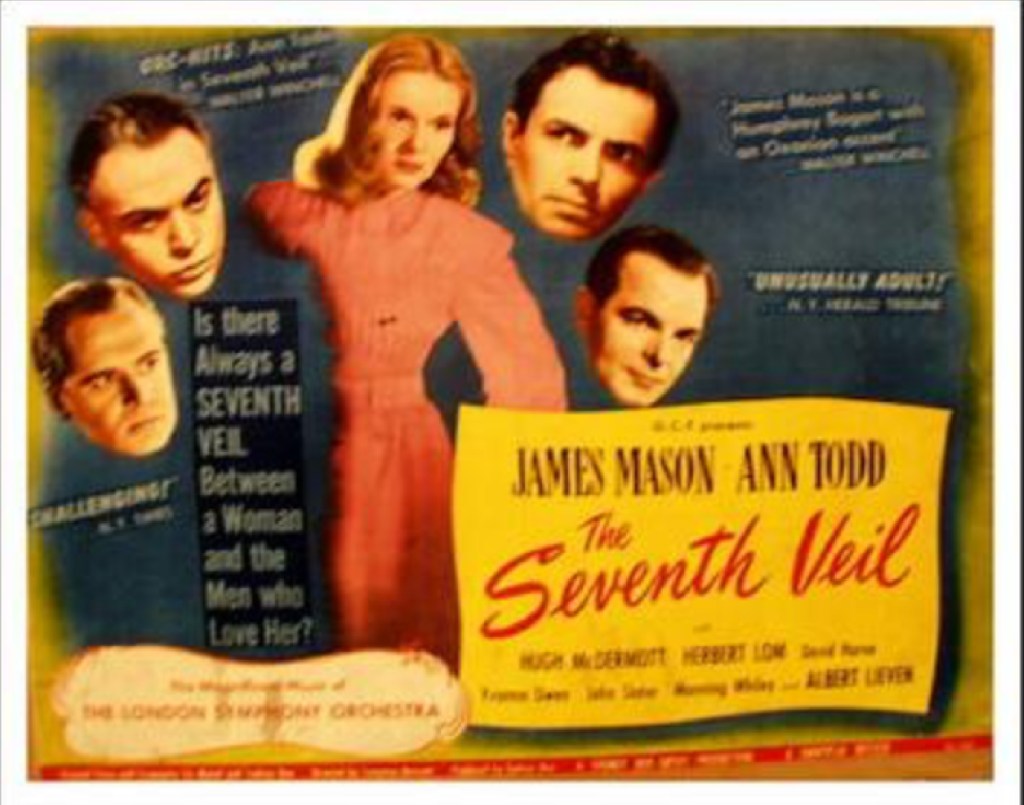
The Seventh Veil (1945)

I bet you can name at least a dozen pictures about a male genius and the woman who loved him. How many can you think of where the woman is the genius and the man devotes his life to serving her art? Ann Todd and James Mason flip the traditional script in a gorgeous tale about the collision of art and desire with some psychological twists.

Screens 11 November

Sleep, My Love (1948)

Claudette Colbert can’t figure out how she woke up on a train without having any memory of getting there. Nor can she account for other foggy recollections or why she’s sleepwalking on her balcony. Could it have anything to do with the strange man in thick glasses who scratched up her upholstery? Is it because of another strange man who seems so solicitous? Or is her handsome husband, played by Don Ameche, with that pillow talk voice, the one responsible? Douglas Sirk goes full Bluebeard.

Screens 18 November

Tension (1949)

Technically, this isn’t a woman’s picture. But there would be no other reason to watch it but for the sublime acid tongue, unabashed greed, and self-absorption of star Audrey Totter. If they had assembled 90 minutes of Audrey Totter scowling at men, I’d still be watching it. And Cyd Charisse is along for the ride.

Screens 25 November

Sass Mouth Dames Film Club series 15

Megan McGurk introduces a pre-Code woman’s picture Thursdays in September.

Tickets available through Eventbrite.

Be sound and wear a mask over your nose and mouth.

MADAM SATAN (1930) screens 2 September

Kay Johnson plays a long-suffering wife with a cheating husband (Reginald Denny). To win him back, she uses a fake accent and wears a smoking hot devil ensemble (by Adrian) for a costume ball aboard a zeppelin. Cecil B DeMille’s picture has one of the wildest party scenes in the pre-Code era.

JEWEL ROBBERY (1932) screens 9 September

Kay Francis plays a society dame who falls for a robber (William Powell) during a heist. She has an exquisite wardrobe by Orry-Kelly, including a velvet gown that defies gravity.

THIRTY-DAY PRINCESS (1934) screens 16 September

One minute Sylvia Sidney is stealing a turkey dinner from the Automat, and the next, she’s propositioned with a job to impersonate a visiting royal for a month. A nosey reporter (Cary Grant) smells something fishy. Sylvia looks super cute (poor or rich) in designs by Howard Greer.

BOLERO (1934) screens 23 September

Carole Lombard joins up with a taxi dancer (George Raft) who dreams of opening his own nightclub in Paris. In real life, Raft paid the bills by pleasuring women on and off the dance floor before he signed a Hollywood contract. Carole is draped in silk and satin confections from Travis Banton.

THE SCARLETT EMPRESS (1934) screens 30 September

Playing Catherine the Great, Marlene Dietrich finds herself trapped in a loveless marriage to a debauched idiot (Sam Jaffe) and lusts after Count Alexi (John Lodge). Josef von Sternberg attempted to match the scenery with perversity of the Russian court. Travis Banton swaddles Marlene in an orgy of fur.

Sass Mouth Dames Film Club Series 14

Series 14 of Sass Mouth Dames Film Club screens four outstanding Bluebeard pictures, a theme which developed from a 17th century French folktale about a nobleman who killed multiple wives. During the post-war era, while men in film noir explored paranoid fantasies about two-timing dames, woman’s pictures gave an audience a chance to imagine their deepest fear about husbands who had murder on the brain. Women kept the home fires burning, but when men returned, did they wonder: Who was the trained killer in their bed?

Megan McGurk introduces the pictures, Thursday in March.

Brooks Hotel Cinema, Drury Street, Dublin.

Popcorn is free!

Tickets are available 13 February through Eventbrite.

Undercurrent (1946)

5 March

Nearly every star of woman’s pictures during the 1930s made a Bluebeard story—even Katharine Hepburn. Initially content to run her father’s house, Hepburn’s character becomes overwhelmed with desire for a suave inventor sporting a chiselled widow’s peak and sad eyes from the war, played by Robert Taylor. What she mistakes for a romantic disposition turns out to be something much more sinister. Bob Mitchum turns up as Taylor’s ‘bad boy’ brother, making traditional ideas about ideal masculinity even more complicated.

Secret Beyond the Door (1947)

12 March

Just like many of us, Joan Bennett’s character prefers to sleep until eleven, and needs three cups of coffee before she can feel conscious in the morning. On holiday in Mexico, she becomes aroused watching two men throw knives, fighting over a woman. Ripe for a fling with a handsome stranger (Michael Redgrave), she gives way to passion, which leads to a trip down the aisle. Once she’s installed in his family home as the new missus, Bennett faces a brutal truth that she married a total stranger who has a macabre hobby.

Too Late for Tears (1949)

19 March

Although Lizabeth Scott’s husband does not try to kill her, he does attempt to keep her from spending a bag of money they find one night, which is a cut too deep, especially for a woman with dreams of mink. Soon enough, she’s in grave danger when Dan Duryea attempts to recover the loot and delivers one of his best sleazy characters—a gangster who takes pleasure in threatening women. Lizabeth Scott is not easily deterred from her plan to buy things. Impressed, Duryea realises that he hasn’t stumbled upon an average housewife.

Sudden Fear (1952)

26 March

Joan Crawford enjoys an independent life based on inherited wealth and a successful career as a playwright at the beginning of the film. During rehearsals for her new theatre production, she sacks an actor (Jack Palance), because from every seat in the house, at any angle, he was not what she considered to be a swoon merchant leading man. On the train home to California, she meets up with the disgruntled actor and succumbs to his charms. After a hasty exchange of vows, Joan discovers her new groom wants her dead, so that he can cash in and run off with a mistress, played by sexpot Gloria Grahame.

(Original Caption) Look Who’s Selling Tickets! New York: Delightfully surprised, these early customers buy their tickets from film actress Joan Crawford, who out put in a personal appearance at the New York movie theater where her latest film, Sudden Fear, held its world premiere. Not only did the glamorous Miss Crawford sell first tickets, but she passed out photos of herself and shook hands with thousands of fans. After all that, she almost passed out herself.

If you want to cancel your ticket, I will send a refund up until noon on the day of the screening.

Use the cancel/refund option on Eventbrite.

Thanks so much for supporting the film club!

Sass Mouth Dames is a non-profit venture.

Sass Mouth Dames Film Club Series 11

Megan McGurk presents four pre-Code smashers from 1932, Thursday nights in September, 2019.

Tickets available through Eventbrite

Blondie of the Follies (1932)

5 September

As Blondie McClune, Marion Davies has only one dress to her name. Although she saves money for a new one, her mother needs the cash to pay rent. Blondie’s oldest friend, Lurleen Cavanaugh, played by Billie Dove, lives in the same cold-water tenement, but soon moves into a penthouse after she lands a spot in the Follies, thanks to her ability to wear a skirt made of pearls. Lurleen changes her name to Lottie and develops notions. The story by Frances Marion and dialogue by Anita Loos captures a passionate rivalry between women who want to shed their origin. And Marion’s impression of Greta Garbo is not to be missed.

Barbara Stanwyck, Adolphe Menjou, Ralph Bellamy, Dorothy Peterson

Forbidden (1932)

12 September

In his memoir, Frank Capra described his goal as a director: ‘I would sing the songs of the working stiffs, of the short-changed Joes, the born poor, the afflicted. I would gamble with the long-shot players who light candles in the wind, and resent with the pushed-around because of race or birth. Above all, I would fight for their causes on the screens of the world.’ Capra also included the pushed-around Janes of the world in his pictures. He made five of them starring Barbara Stanwyck. In Forbidden, Capra’s answer to Back Street (1932), Stanwyck plays a small-town librarian. Tired of dull routine, Stanwyck longs for adventure. She cashes in her savings for a new wardrobe and lavish cruise, where she hooks up with a married man. Will she be content as a mistress?

Merrily We Go to Hell (1932)

19 September

Dorothy Arzner’s cautionary tale shows women why they should avoid a hasty marriage to a random lad from a party. Arzner’s picture scuppers the romantic myth that women can save men from themselves. Sylvia Sidney stars as a socialite who falls for a dissolute writer, played by Fredric March. Each time he proves unworthy, she ignores the facts. What happens when she agrees to a modern marriage on his terms? James Baldwin once wrote that Sylvia Sidney ‘was the only American film actress who reminded me of reality’. Sylvia Sidney bore her share of troubles onscreen with an angelic grace that was the antithesis of hardboiled dames from the pre-Code era.

Shanghai Express (1932)

26 September

Series 11 closes with the fourth film Marlene Dietrich made with Josef von Sternberg, which was the top-grossing film from a stand-out year for pre-Code woman’s pictures. Nominated for Best Picture and Best Director, it won for Best Cinematography from Lee Garmes. In an elaborate feathered costume designed by Travis Banton, Marlene looks like an exotic bird who longs for wings fast enough to carry her away from men. You can’t beat Dietrich and von Sternberg for style, mood, and dramatic atmosphere. Anna May Wong gives a standout supporting performance.

Sass Mouth Dames Film Club Series 8

Join Megan McGurk for a sterling collection of Pre-Code woman’s pictures. Let’s revisit an era when Hollywood took women on the screen and in the audience seriously.

Sass Mouth Dames Film Club Series 8 meets each Thursday night in January at 7.00, in the Brooks Hotel Cinema, Drury Street, Dublin.

Only a tenner in!

Tickets through Eventbrite.

Our Blushing Brides (1930)

3 January

In woman’s pictures, a reliable formula presents a cautionary tale of three women who seek to make their fortune. Set in a department store among women who work behind a counter, or model clothes as ‘mannequins,’ they pool resources in flat shares and skip lunches to afford clothes. Joan Crawford, Anita Page, and Dorothy Sebastian bide their time on stingy wages while they fend off a pack of society wolves. Joan Crawford tries to keep her friends from falling for the cheap lines pick up artists use. The picture includes fashion show sequences featuring swoonworthy designs by Adrian.

Safe in Hell (1931)

10 January

Next time you hear someone make a sarcastic comment about ‘Hollywood endings’, as a shortcut for saccharine fade outs, point them in the direction of Pre-Code Hollywood pictures like Safe in Hell. In one of the most notorious Pre-Codes, Dorothy Mackaill protects herself from a customer’s assault, and afterward, hides out in a Caribbean bolthole to avoid extradition. At first, she thinks boredom is her worst problem. When she accepts an invitation from the men who loiter in the hotel lounge, they compete for her as though she were a roast chicken at the end of forty day fast. William Wellman’s production reminds us that women are never safe when men are around.


Vanity Street (1932)

17 January

Helen Chandler, tired, hungry, and homeless, smashes a window so she can at least have three hots and a cot in prison. A police detective (Charles Bickford) takes pity on a woman down on her luck. He offers a meal and his sofa, and then gets her a job in a chorus line. The real star of this picture though is Mayo Methot, better known for being the third Mrs Bogart. Mayo Methot had a gift for playing characters who learn difficult truths about things like inconstant lovers and the fleeting nature of youth and fame. She lays bare the emotional contours of women who have been tossed aside. Not to be missed.

Ladies They Talk About (1933)

24 January

During a bank heist, Barbara Stanwyck gets pinched. She doesn’t squeal on her boyfriend’s criminal rackets. She hopes to gain the influence of a popular radio preacher she grew up with, and have the sentence suspended. The plan doesn’t work, so she joins the women’s prison as a ‘new fish’. Stanwyck proves a quick study for how to manage a dame looking for a fight. The scenes behind the walls resemble a sorority house more than the hoosegow. Despite a carceral effect, women on the inside mitigate their grim plight with decorative touches applied to their uniforms and jail cells. You can’t keep a good dame down, even when she’s behind bars.

Heat Lightning (1934)

31 January

Where do you go after you’ve had enough of men and life in a chorus line? If you’re Aline MacMahon, you get as far away as possible–the Mojave desert. She opens a filling station and café with her younger sister, played by Ann Dvorak. Wearing overalls, with her mermaid tresses tucked under a bandana, MacMahon limits her worries to heat, rattlesnakes, and keeping her sister out of trouble. Then one day an old flame (Preston Foster) shows up, on the run from the law. Suddenly the great big desert is too small. Cornered, with a siege mentality, a resourceful dame does what she must. To lighten the drama, Glenda Farrell and Ruth Donnelly trade barbs. Director Mervyn LeRoy doesn’t waste a moment in this 63-minute gem.